In an indoor grow, having more light does not necessarily mean making better use of it.
As the canopy thickens, the upper leaves intercept much of the radiation coming from the fixtures. The outcome is familiar: high intensity at the top of the plant and progressively less light in the middle and lower zones.
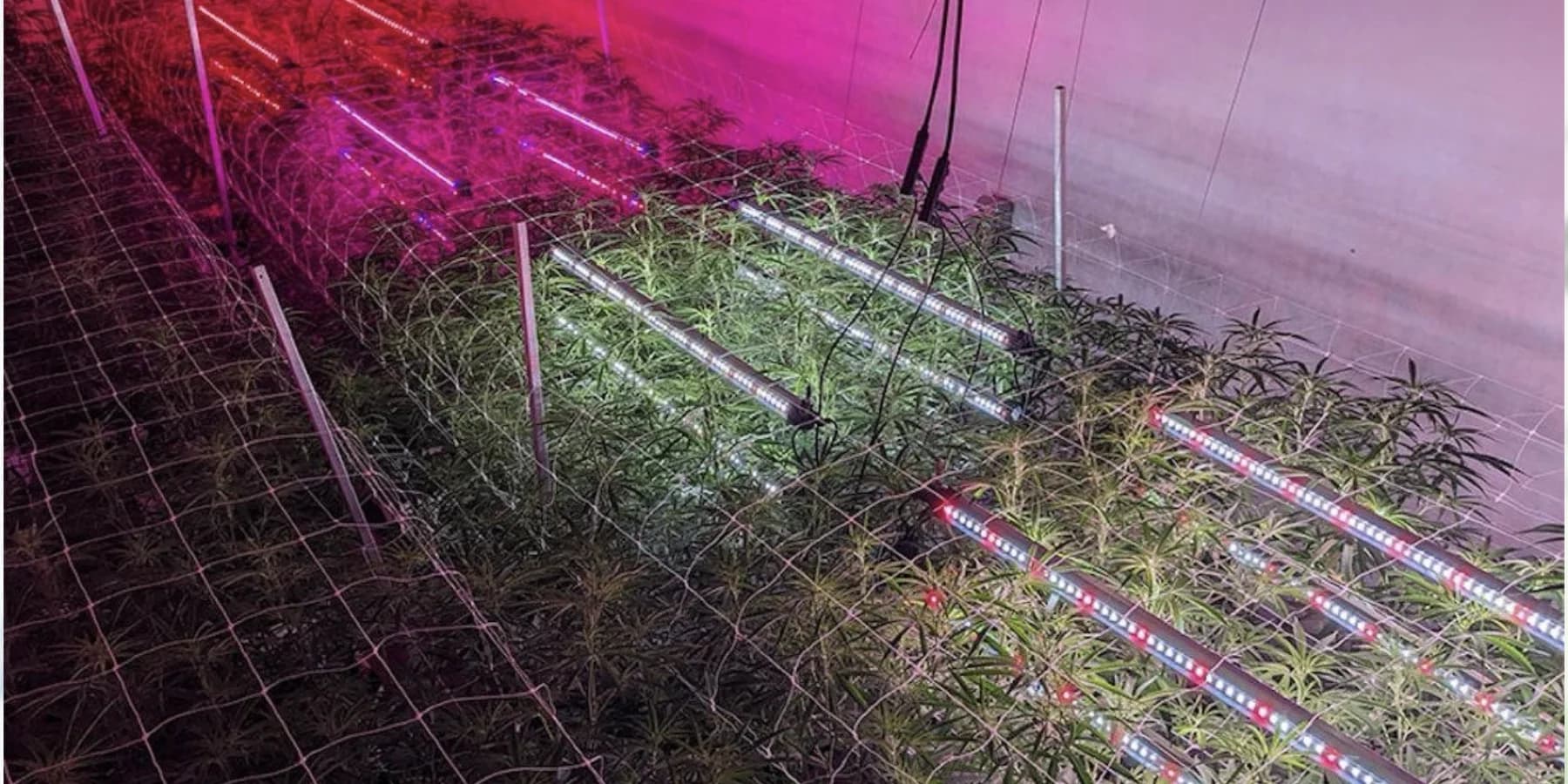
Under-canopy lighting proposes a different approach. Instead of concentrating all the light above the crop, it introduces light below or within the canopy to reach areas that traditionally receive far fewer photons.
What makes this interesting is that it is no longer just theory. Several studies have examined the effect of this strategy on yield, uniformity and flower quality.
What is under-canopy lighting?
Under-canopy lighting is a general concept based on complementing overhead lighting by bringing light to the lower zones of the crop. Within this strategy there are two main configurations:
Subcanopy lighting (SCL): fixtures are placed beneath the canopy to illuminate the lower parts of the plants.
Inter-canopy lighting (ICL): light is introduced inside the canopy itself, distributed at different heights.
In both cases the principle is the same: achieving a more uniform light distribution throughout the plant.
The problem with lighting only from above
In a conventional installation, practically all radiation comes from fixtures positioned above the crop. But a plant is not a flat surface.
The upper leaves intercept a significant share of the light before it can penetrate inward. The denser the canopy, the greater the gap between the radiation received at the top and what remains available in the lower zones. This can translate into substantial differences between one part of a plant and another.
The goal of under-canopy lighting is not simply to add more watts. It is to place photons where they can actually be used.
Science has been studying this for years
In 2018, researchers at the University of Guelph published the study «Improving Cannabis Bud Quality and Yield with Subcanopy Lighting» in HortScience. The work analysed the effect of adding subcanopy lighting with different spectral compositions.
The researchers observed yield improvements compared with the treatment without lower lighting, and also detected effects on cannabinoids, terpenes and uniformity between different parts of the plant. The study thus introduced a particularly relevant idea: lower lighting could affect both the quantity produced and certain characteristics of the final product.
More recent studies go a step further
Research published in 2025 in the scientific journal Plants directly compared three lighting strategies:
Top lighting (TL): overhead lighting only.
Subcanopy lighting (SCL): overhead lighting complemented from beneath the canopy.
Inter-canopy lighting (ICL): lighting also distributed within the canopy itself.
The trial was carried out under controlled conditions with 72 genetically identical plants distributed across the different treatments. The results showed that both SCL and ICL achieved a more homogeneous light distribution and increased inflorescence yield compared with overhead lighting alone.
Up to 29.95% more yield
The inter-canopy treatment produced the largest absolute increases in the trial. The researchers recorded approximately:
+29.95% in dry inflorescence yield
+24.4% in THC accumulation
+12.5% in total terpene concentration
These are significant figures, but they must be interpreted correctly. They do not mean that installing under-canopy lighting will automatically increase the production of any crop by 30%. The results correspond to specific experimental conditions, a particular genetic line and a given lighting configuration.
What matters is that they show that modifying the vertical distribution of light can produce measurable differences in yield and quality.
More yield, but also greater uniformity
There is another aspect that is particularly interesting for professional growing: it is not only about producing more grams. It also matters that the harvest is as uniform as possible.
In the 2025 study, the subcanopy and inter-canopy treatments reduced the differences between different zones of the canopy. The researchers observed greater uniformity in productive and chemical parameters, including reductions of more than 50% in the variability of THC and terpene yield.
This can be particularly relevant in commercial facilities, where product consistency carries considerable value.
What if we do not add more light, but distribute it better?
Here lies one of the most interesting questions around under-canopy lighting. If we simply install more fixtures, we are also supplying more energy to the crop. Part of the yield increase could therefore be explained simply because the plants receive more photons.
But what happens if we keep roughly the same total amount of light and simply change its distribution? Other inter-canopy trials have examined precisely this possibility.
In tests reported by Cannabis Business Times, part of the overhead lighting was redistributed into the canopy while maintaining the total DLI. The reported results showed approximately 20% more floral yield and 27% more premium flowers relative to small flowers, with no significant change in potency.
These results come from industry trials and should be distinguished from peer-reviewed academic studies, but they raise a compelling question: perhaps we do not always need more photons; perhaps we need to distribute better the ones we already have.
Efficiency: grams per kWh, not just grams per plant
This point also changes how a lighting installation should be assessed. Asking only how much yield increases gives an incomplete picture. In professional growing we also need to know how much energy was required to achieve that increase.
A far more interesting metric is therefore: how many marketable grams do we obtain per kWh consumed?
The study published in Plants found differences between the strategies analysed. While inter-canopy achieved the largest absolute increase in production, subcanopy showed greater energy efficiency in certain parameters related to inflorescence and cannabinoid production. This shows that maximum yield and maximum efficiency are not always exactly the same thing.
There is no automatic +30%
The scientific results are promising, but an overly simple interpretation should be avoided. The real performance of an under-canopy system will depend on factors such as:
canopy architecture and density
genetics
PPFD and DLI
installed power
light spectrum
fixture positioning
leaf and ambient temperature
climate control
crop management and defoliation
additional energy consumption
Comparing systems solely by power or by percentage increase in yield can therefore be misleading. The evaluation should be carried out across the installation as a whole.
A new way of understanding indoor lighting
For years, the evolution of indoor grow lighting focused mainly on achieving more efficient fixtures capable of generating more photons per watt consumed. Under-canopy lighting introduces a second variable: where do we place those photons?
The available research indicates that bringing light into the lower and inner zones of the canopy can improve light distribution, increase yield and deliver more homogeneous production.
This does not mean overhead lighting is going to disappear. It means we can start to consider the plant as what it really is: a three-dimensional structure that needs light at different heights. And that change of perspective can matter as much as increasing fixture power.
How to integrate UnderCanopy
Our UnderCanopy SUBFLUX 120W combines wavelengths geared towards the flowering phase. Get in touch if you want to integrate it with your current Mega Optic installation.
References
Hawley, D., Graham, T., Stasiak, M. & Dixon, M. (2018). Improving Cannabis Bud Quality and Yield with Subcanopy Lighting. HortScience, 53(11), 1593–1599.
Garrido, J. et al. (2025). Subcanopy and Inter-Canopy Supplemental Light Enhances and Standardizes Yields in Medicinal Cannabis (Cannabis sativa L.). Plants, 14(10), 1469.
Can Intercanopy Lighting Improve Cannabis Yield and Quality? Cannabis Business Times.
New Cannabis Research: Intercanopy Lighting Produces 20% Yield Surge and 27% Larger Buds. Cannabis Business Times.