HortiBloom

Solutions · Large scale

Greenhouse LEDs:
supplemental light that actually delivers

Your greenhouse loses between 35% and 50% of the available sunlight to the structure and glazing alone. We explain how we calculate, design and install the LED light that makes up that deficit — without blowing up your bill.

2.9µmol/J
Full-system efficacy
−42% kWh
Consumption vs. equivalent HPS
IP65
Protection for humid environments
5years
Manufacturer warranty

Recommended fixtures

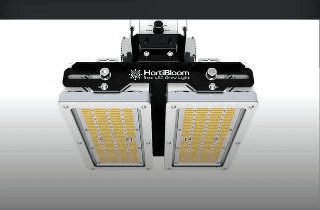
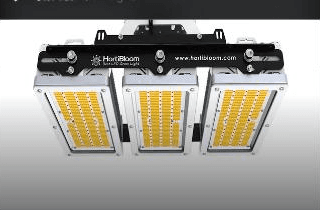
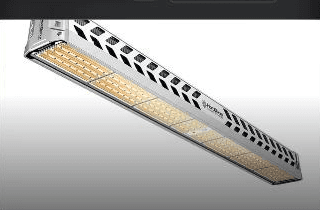
Solux and Flux range for greenhouses

Our highest-coverage fixtures, designed for greenhouses — both for medicinal cannabis projects and conventional horticultural growing.

Prices include VAT. Coverage figures are indicative at a target PPFD of 800 µmol/m²/s — they are adjusted according to your project study.

The challenge

Sunlight isn't always enough

In autumn and winter, or on cloudy days, the greenhouse receives less light than the crop needs to keep up its growth rate.

The glazing, the structure and the greenhouse orientation filter and reduce solar radiation before it reaches the crop — typically by 35% to 50% compared with the outdoors.

When that loss coincides with short winter days, the crop fails to reach the DLI (the total amount of useful light it receives over 24 hours) it needs to photosynthesise at the expected rate. That is where supplemental LED light comes in: it doesn't replace the sun, it complements it by exactly the amount that's missing.

100%
DLI available outdoors
50–65%
Actual DLI inside the greenhouse

How we size it

PPFD and DLI: the basis of any project

You don't buy LED light by wattage. It's sized by the amount of useful photons your crop needs, in its phase and its photoperiod.

PPFD (µmol/m²/s) measures light intensity at a given instant.

DLI (mol/m²/day) is the sum of that light across the whole photoperiod — the figure that actually predicts growth.

DLI = PPFD × light hours × 3.600 ÷ 1,000,000

With your area, your crop and the natural daylight hours available, we calculate the supplemental PPFD required and give you back the fixture layout and the budget — at no cost.

TARGET DLI (mol/m²/day)

Cannabis (vegetative)25–35
Cannabis (flowering)35–50
Other horticultural crops12–30

We mostly work on medicinal cannabis projects; occasionally we also size conventional horticultural greenhouses. We validate the real DLI for your area and crop before proposing a configuration.

Why switch

LED vs. HPS / sodium: the comparison

Sodium (HPS) is still installed in many greenhouses. Here's how it compares against a properly sized LED system.

HortiBloom LED HPS / Sodium

Light efficacy µmol of useful light per joule of energy

LED2.7–3.8 µmol/J
HPS1.0–1.7 µmol/J

Energy dissipated as heat versus energy converted into useful light

LED~33% as heat
HPS~66% as heat

Service life hours of operation

LED50,000+ h
HPS10,000–24,000 h

Sources: efficacy and service-life ranges per industry technical literature (Thrive Agritech, Sollum Technologies). The lower heat emitted by LED reduces thermal stress on the crop in summer and lets the fixture be placed closer to the canopy.

More than just replacing light

LED does more than keep the crop active

Properly sized, supplemental light does more than add DLI: it also protects the photoperiod and improves quality and yield.

Protected photoperiod

A very low-intensity night interruption (1–2 µmol/m²/s, roughly 22:00–02:00) keeps the crop vegetative and avoids premature or uneven flowering, or hermaphroditism from long nights or nearby light pollution.

Programmable by phase

Higher yield

The relationship between supplemental light and yield is practically linear: recent cannabis studies document increases of up to 4× in flower weight when the supplemental light supplied is multiplied by a similar factor.

Sized by PPFD/DLI

Better final quality

It's not just «more light always»: adjusting intensity by phase (less in vegetative, more in flowering) helps preserve the terpene profile against uniformly high light. Our automatic control makes that adjustment without manual intervention.

Terpenes and flower structure

Sources: recent research on photoperiod and supplemental light in cannabis (Thrive Agritech; Frontiers in Plant Science; Scientific Reports). Indicative results — the exact effect depends on variety, phase and light programme.

Installation

Three ways to position the light

The mounting strategy changes with the crop height and canopy density.

+0% base

Toplighting

Fixtures above the canopy, the standard solution for most crops. A starting point before considering reinforcements.

+20–24% yield

Interlighting

Bars within the canopy for tall crops (tomato, cucumber), bringing light to the mid leaves that toplighting can't reach.

+20–30% yield

Under-canopy

Light beneath the canopy for the lower leaves, improving photosynthesis in the lower part of the plant — our UnderCanopy SUBFLUX line.

Turnkey installation

Factory-automated, ready to switch on

We configure your greenhouse's photoperiod controllers and pyranometers during installation. The pyranometer measures real solar radiation at every moment and the system automatically raises or lowers the LED intensity to make up exactly what's missing.

The result: no one has to watch the sky or reprogram anything by hand — the greenhouse is ready to use, and you only adjust the crop parameters if they change.

Solar-radiation pyranometerPhotoperiod controllerCommissioning included

LED INTENSITY BY SOLAR RADIATION

Clear sky · minimum supplementOvercast sky · maximum supplement

Indicative ranges from trial studies on interlighting/under-canopy. The light plan defines target PPFD uniformity >80% and avoids shadows from the greenhouse structure itself.

We start with your greenhouse

Tell us about your project and we'll return your light plan

Area, crop and phase. With that data we calculate the fixture layout, expected PPFD/DLI and budget. No cost, no commitment.

  • Fixture layout and expected DLI
  • Firm quote, no commitment
  • Done by our technical team, not a salesperson
WhatsApp →

Reply during business hours